Duplicate Pages, and the Tag Raleigh Nails
88.0% of Raleigh sites carry a canonical tag, 2nd of the 24 cities I audited. The month I got that tag wrong, and why the software deserves most of the credit.

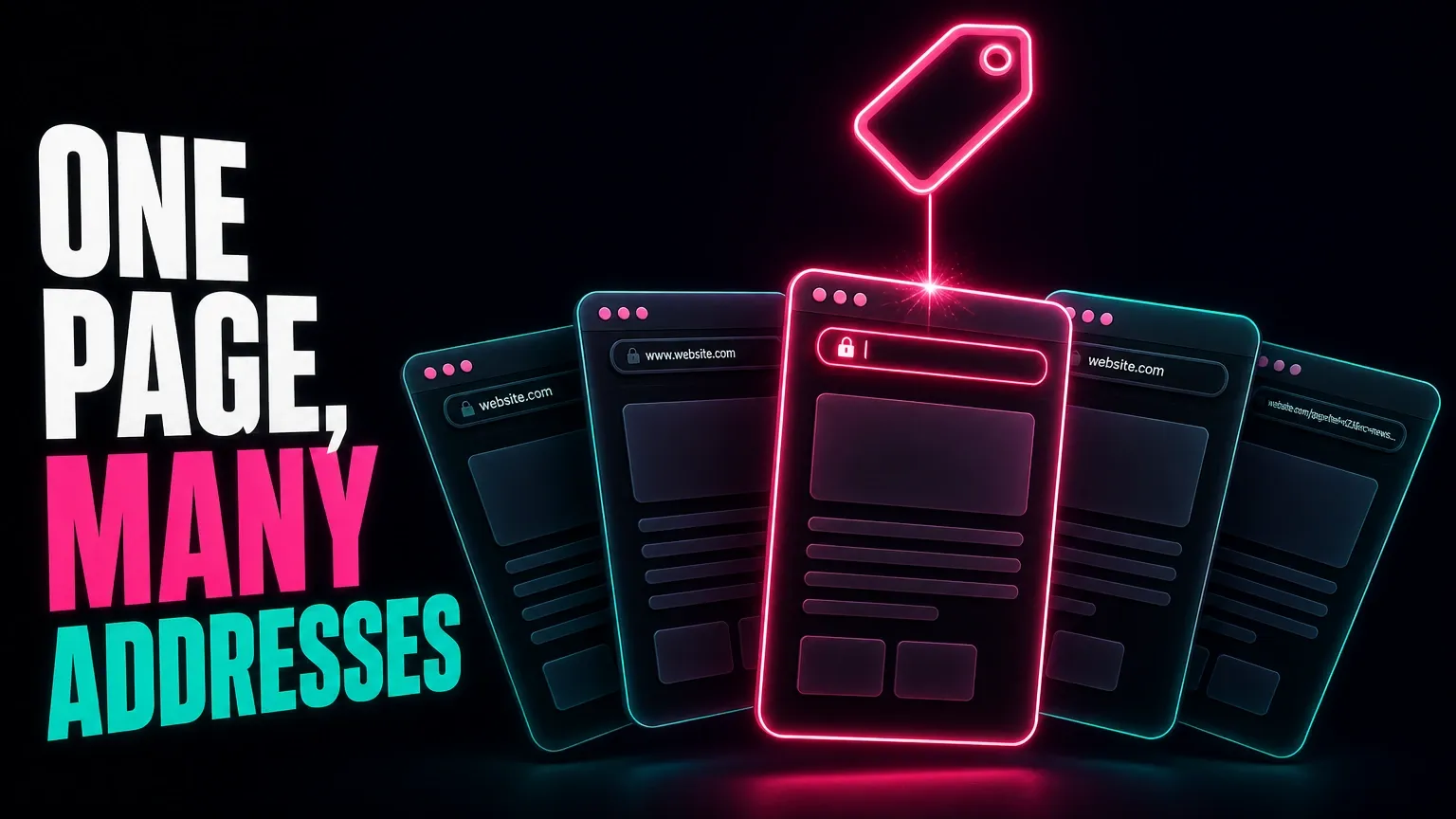
How many web addresses does your homepage have?
Most Raleigh owners tell me one, and I understand why, because one is the only version they ever type. The real answer is usually four or five, and every last one of them belongs to you.
Your site answers to the version with www on the front and the version without it, the http one and the https one, plus whatever came back with a tracking tag glued to the end after your last Facebook ad.
Same page every time. To a search engine, that pile can look like a stack of separate pages all saying exactly the same thing, and I have yet to meet an owner who asked for that or even noticed it happening.
Travel businesses have it worst of the 47 trades I sort, and Google quietly keeps whichever copy of the page it likes.
A canonical tag is the single line that sorts it out, tucked into the top of your page, saying nothing more than “the real address for this page is right here.”
Raleigh, you handle this better than almost any city I audited. 88.0% of Raleigh sites carry a canonical tag, which is 2nd of the 24 cities I audited, and I don’t think you are getting the credit for it.
Google’s own documentation calls it a strong signal, and explains that it rolls the credit for all those separate addresses, including the links pointing at them, into one preferred address, while skipping it leaves Google to pick whichever version it happens to like best.
Would you let a search engine flip a coin over which of your five addresses gets treated as the original?
The month I cost a client
I know what that coin toss costs, because I lost it once on a real job and my client paid for it.
Any decent build starts somewhere private, on a staging address with a nonsense subdomain that nobody outside the project is meant to see. I built her new site there, tested it there, moved it across on a Thursday, watched the homepage load on the live address, and called it finished.
Every page on that new site was still pointing its canonical tag back at the staging address. I had carried the setting over along with everything else and never once looked at it.
Google did exactly what I had told it to do, and carried on treating a private address nobody could reach as the real version of her business.
Her phone went quiet. Not dead, quiet, which is far worse, because quiet is the sort of thing you blame on the season or the weather or the economy. Have you had a month like that and never worked out why?
It took me most of a month to find it, and I found it in the end by right clicking the page and reading the source code, which is a thirty second job I had skipped at launch because I was so sure of myself. I broke a therapist’s site the same careless way during a redesign, deleting a line of code and taking months to work out what I’d done.
I fixed it for nothing and I have never billed anybody for that month since. It sits at the top of the checklist I run before any site goes live now, above all the things a client actually notices, and that checklist runs on every site I build, Raleigh ones included.
The city that gets this right
The national figure is 84.9%, so Raleigh is comfortably clear of the pack rather than squeaking past it.
I audited 3,344 Raleigh websites to land on that, so it isn’t a fluke pulled off some tiny handful of samples. There is a real habit sitting underneath it.
Nice work. Some of the credit isn’t yours, though.
Are you sure your designer did this?
Ask the person who built your site when they last typed a canonical tag by hand, and watch what happens to their face.
The software running this city is not exotic. 36.8% of the Raleigh sites I audited are running WordPress, and the next four names down my list are Squarespace at 7.0%, Wix at 6.9%, Shopify at 4.9% and Drupal at 3.1%. Add those together and you will not reach a hundred, because one site can answer to two platforms and a good number never say what they were built on.
WordPress has printed that canonical line on ordinary pages by itself for years, with nobody switching it on, and its own developer documentation is about one sentence long on the subject. Is anyone logging in on a Sunday night to type that by hand?
Can I prove which is which? No, and I would be lying if I claimed I could, because my audit only ever sees the finished page and never sees who typed what. The rest of that list may well behave the same way, but my audit can’t show me that, so I leave it as a maybe.
The biggest slice of this city is being handed credit for a line of code that nobody in it wrote.
Machines finish their homework. People don’t.
Sort my checks by who does the actual work and the results get a little awkward.
The lines a plugin drops in by itself are all but universal here. A title tag sits on 99.2% of Raleigh sites, and the canonical tag on 88.0%. Nobody sits down and types either one. They arrive with the software, in the night, unasked.
The work a person has to sit down and do falls away sharply. Alt text reaches 54.9% of the pictures on an average site here, and every one of those lines got there because a human being wrote it.
Raleigh isn’t lazy, and I want to be clear about that. Raleigh is normal. Software carried this city most of the way and then set the bag down at the exact spot where a person has to start typing.
The half your customer can see
My own argument has an uncomfortable edge on it, because the tags software handles are the ones a customer never sees, and the tags needing a person are the ones a customer actually reads.
Nobody has ever chosen a plumber because of a canonical tag.
She arrives from Google, gives the top line of your homepage about a second of her attention, and decides whether you sell what she needs. If that line says “Welcome to Our Website” she is gone, and you have spent your best piece of copy on absolutely nothing.
Alt text is what a page falls back on when a photo refuses to load. She opens your gallery on one bar of signal, half the pictures don’t arrive, and where your best work should be she gets a column of little grey boxes, so she never sees the thing that would have sold her.
That phone of hers is where this city slips, too, because Raleigh drops a long way down the city rankings the moment you open its websites on one.
Where the tag can’t help you
A canonical tag also won’t get a nervous customer past a browser warning.
Does your own address still work with the s knocked off the front? You should land on the secure version anyway. When you don’t, she gets a full screen warning about your site being unsafe at the exact moment she was about to hand over her phone number.
87.9% of Raleigh sites send insecure traffic to the secure version, a shade under the 88% I found nationally.
Someone has to go into the hosting settings and switch that on, and no plugin is going to creep in and do it while you sleep.
So my compliment arrives with a bill attached. The half of your website a robot can handle is in excellent shape across this city, and the half needing an afternoon and a keyboard is closer to a coin toss.
Which half is yours?
Open your homepage on a computer, right click, choose view page source, and search that wall of text for the word canonical.
The promise I’ll make you is a small one. If the line is sitting there with your own address in it, that is one thing you never have to think about again, and I mean never again. If it points somewhere strange, you have just found in thirty seconds the thing that took me a month, and you get to keep the month.
Then do the harder one. Read the top line of your homepage out loud to a friend and ask her to tell you, from that line alone, what you sell and who you sell it to.
That half takes an afternoon, and no software is ever going to write it for you.
My free website audit covers both, if you would rather I looked.