Entertainment Is Great at Links and Lousy at Headlines
Entertainment sites link their social profiles better than almost any trade I audit, at 73.0%, and put a heading at the top of the page worse than almost any. I made the same mistake myself.

The poster lands in your inbox around four in the afternoon and it’s already up on Instagram before five.
You crop it square, tag the band, drop a countdown sticker on the story, and paste the link into three separate group chats before your coffee has finished going cold.
Then you drive over to the venue. An entertainment business runs on that rhythm, and your website doesn’t cross your mind again until the artwork for the next show arrives.
Is that your week? It’s the week almost every owner in this business describes to me.
I’ve watched people in your trade work exactly like that for years, and I’m in no position to lecture anybody about it. I built a website that fit the pattern perfectly, and it cost a client of mine most of a season.
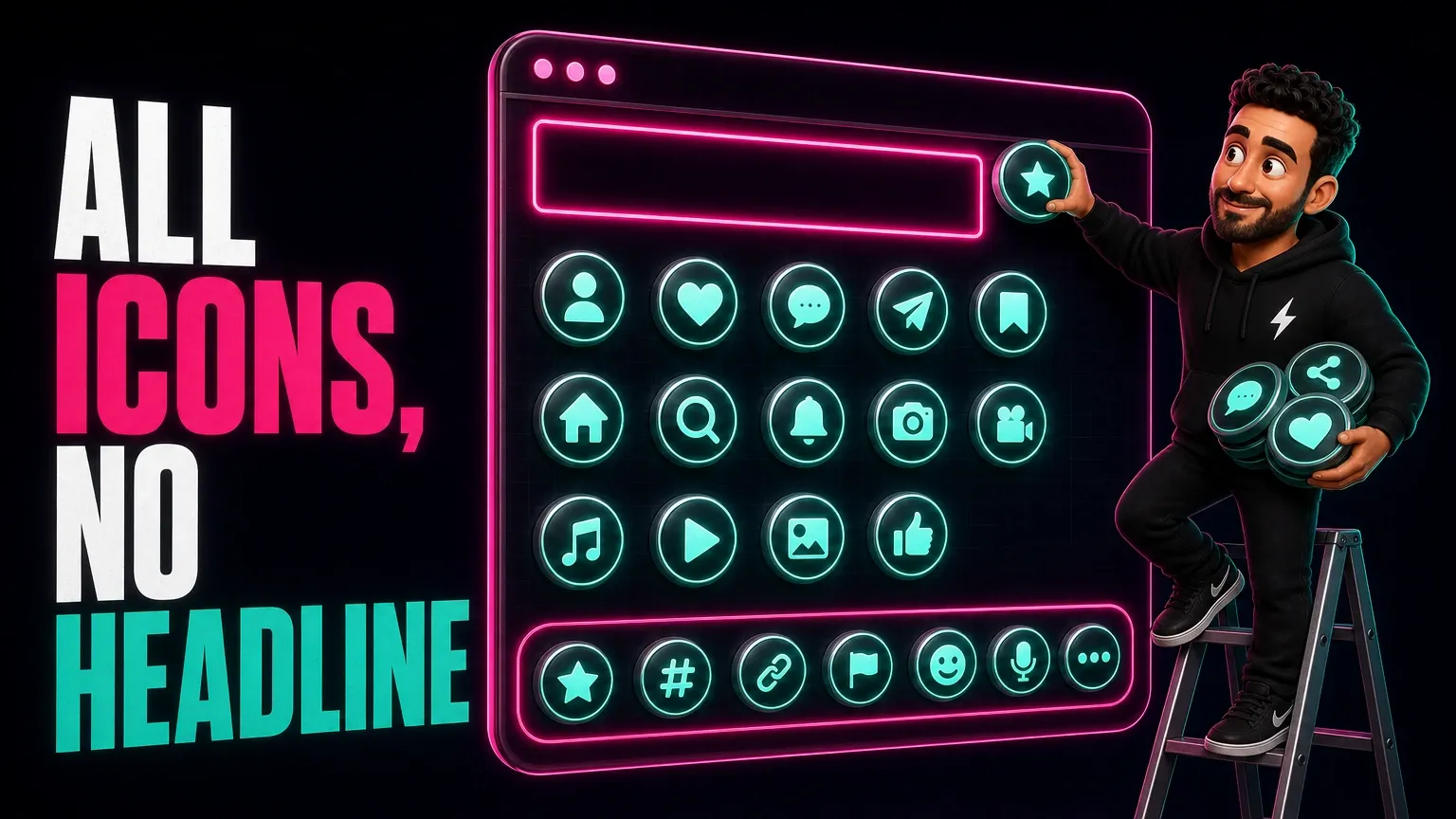
Then I went and looked at everybody else’s. 73.0% of entertainment sites link out to a social profile, one of the best rates I get from any trade, and they finish 40 of 47 on whether there’s a heading at the top of the page.
The comedy club I got wrong
Years ago I built a website for a comedy club in an old bank building, and it had a low ceiling, terrible parking, and one of the best rooms I’ve ever sat in.
The homepage opened on a wide photograph of the stage with the lights up and the seats still empty, and honestly, I’d defend that photograph today.
Underneath it sat the calendar, and underneath that, a live strip of their Instagram, refreshing itself with whatever they’d posted that week.
The social icons were everywhere. Header, footer, beside the phone number, every account they had, and I clicked every single one of them the night before we launched.
He loved it, I loved it, and it was sitting in my portfolio by the weekend.
The line I never wrote
Across the top of that photograph sat the club’s name, in a font I’d spent an entire afternoon choosing. Just the name.
Nothing saying it was a comedy club. Nothing naming the city. Nothing about Friday and Saturday at eight, doors at seven, nineteen and over.
A woman on her couch at nine on a Wednesday evening gets one line out of you before she decides what to do with her Friday. The big words at the top of a page are the H1, and the ones I gave her were a proper noun and nothing else.
Either she understands immediately what she’s looking at, or she’s back in the list with nine other things that are also happening this weekend.
He telephoned me in March, seven months after we launched, to say the touring names were selling out while everything else in that calendar was quietly dying.
So I finally looked him up the way a stranger has to, instead of typing his address in from memory the way the two of us had been doing all winter.
Google had assembled his search listing out of the club’s name and the word Events, because that was all it had to work with, and that was all I’d given it.
Have you ever seen yours? Not your homepage, the listing, the thing a stranger reads about you before your website ever gets a turn.
The whole trade does it
I’ve since opened 1,821 entertainment websites, out of 2,535 businesses I sampled across 24 cities, and that club’s homepage turned out to be a portrait of the entire industry.
73.0% of them link out to a social profile, comfortably better than the 66% I get across my whole sample and 14 of 47 trades.
Nothing else this industry does ranks that well.
Those icons earn their place for a reason nobody clicks. In Bismarck they’re the thing that proves a business is still open, because a feed with something on it from this week answers a question your About page never will.
Now the top of the page. 67.3% have a heading up there where 73.7% manage it everywhere else, and 40 of 47 on the same run.
Strong at pointing away from themselves. Close to the worst at explaining what they actually are.
Why the icons are the easy half
I don’t think that gap makes anybody in this business lazy, and I’d argue with the person who suggested it.
Your working life happens on apps where the artwork does the talking and the caption is a formality, and nobody has ever asked a poster to introduce itself.
The icons are easy for a second reason. A decent theme drops that row into your footer for you, you paste five addresses into five boxes on a Tuesday, and the job is finished forever.
The headline is a decision instead of a chore. No software on earth will make it for you, and no amount of money spent on photography will cover for it afterwards.
So who wrote yours, you or the person who built your site? On plenty of the pages I open, the honest answer is that neither of them ever got around to it.
An industry full of people who are brilliant at promotion ends up with homepages that never introduce anybody to anything.
The same habit shows up further down, where 28.3% of these sites publish anything of their own against 37% nationally, because the writing all went to the app instead. A baker in Winston-Salem posted every day for a year and her website never once mentioned that the account existed.
Add it all together and the industry lands on 71 out of 100, which is 32 of 47 industries, which is a middling result assembled from one real strength sitting beside one real hole.
What one sentence did
We changed the headline on that homepage and nothing else about the page moved. A woman with two escape rooms got told she needed more content, and one line at the top of her page did what twelve blog posts were supposed to.
It named the room, the city and the nights, in about nine words, and it was easily the least imaginative thing on the entire website.
His search listing started reading like a comedy club instead of a riddle, and the calls asking whether he hosted wedding receptions dried up inside a month.
He never once thanked me for it, which seems fair enough to me. I’d charged him for the website that caused the problem.
Three things I changed afterwards
None of them cost anything, and I’ve done all three on every project since that phone call in March.
- The top line gets written first, before the photography, before the calendar, and before I open a design tool at all.
- I hand that sentence to someone who’s never heard of the business and ask what they sell and where. A shrug means I write it again.
- I look the website up in Google before launch, on a phone, signed out, the way an actual stranger would have to.
Most of the entertainment sites I build now begin life as one sentence in a text file, and nothing whatsoever gets designed until that sentence is right.
Does all that sound like an enormous fuss over one line of text? It’s the only thing on your homepage a stranger is guaranteed to read.
Send me your homepage
Open it right now, on your phone, and read the biggest words at the top of it out loud.
Do they say what you are? Do they say where you are? Would the woman on the couch on Wednesday evening know whether you’re worth giving up her Friday for?
If you’d rather I looked instead, send me the address and I’ll tell you what your top line currently says, what Google is making of it, and which of your icons goes somewhere dead. Ten minutes of my afternoon, and I’ll be just as blunt about the parts that are already good.
And if the words up there already name the work, the town and the nights, send it over anyway. I collect those, and they turn up a lot less often than they ought to.