One Flower Shop, One Address
Florists carry the canonical tag on 89.8% of their websites, 3 of 47 trades, and not one has ever raised it on a call. The habits underneath their best result.

Your phone has locked itself again.
Wet hands, the cold room at the back of the flower shop, a bucket of eucalyptus under one arm, and a screen that refuses to recognize a thumb which has been sitting in water since a quarter to six in the morning.
There’s a funeral tribute going out at ten, a wedding consultation at half past two, and the wholesaler has shorted you on spray roses for the third week running.
I’ve stood around in enough back rooms at that hour to know exactly what isn’t on your mind. A line of code you can’t see, have never been shown, and have certainly never been asked about.
And yet this trade beats nearly everything else I audit at exactly that.
The line nobody in a flower shop has ever mentioned to me
Your shop has more than one way into it.
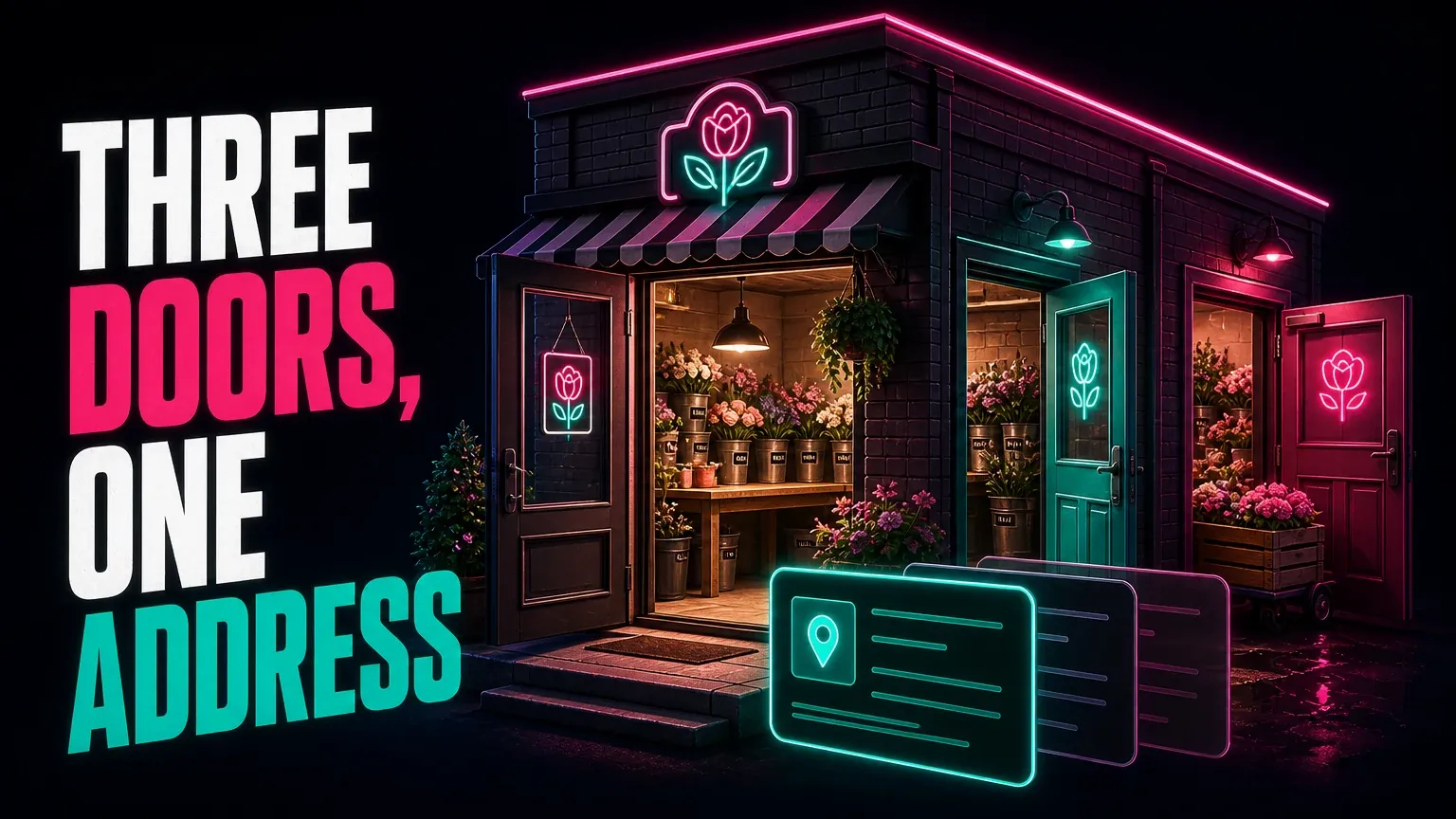
The street door, the side door out to the parking lot, and the back door the delivery driver uses at dawn while you’re still finding the light switch. Three ways in, one address printed on the invoice.
Your homepage works along the same lines. It answers to your name with the www on the front and without it, with a slash on the end and without one, and to an older address a wedding blog linked to back in 2019.
A canonical tag is the invoice line. It’s the version you’d say out loud if a stranger stopped you and asked where you are.
I have never once had a florist raise the subject on a call, which makes it faintly comic that they finish 3 of 47 for it, on 89.8% of the websites I opened against 84.9% of everything I audit.
So who’s doing it? Nobody in the shop, I promise you that.
Habit one: they never built a second website
The way I watch this get broken, over and over, is a shop quietly deciding to own two of itself.
A shop does well, the wedding work takes off, and someone suggests a separate website for that side of the business with its own name, its own photographs and its own little logo. I have built that second site for people. I regret most of them.
Now there are two of you online. Both real, both yours, both saying similar things about similar flowers, and a search engine somewhere has to decide which one is actually the florist.
The shops that come out on top didn’t do that. They added a wedding page to the website they already owned and then got on with their morning.
One shop, one website. Deeply boring, and it explains an awful lot of this.
Would a bride have been able to tell which of the two was really you?
Habit two: last year’s page comes down
I have walked into flower shops the week after Mother’s Day and found the whole place already changed over.
The signage, the bucket cards, the board out on the sidewalk. Gone by Tuesday, because a window cannot go on saying May halfway through June.
The shops I score highest do exactly the same thing with their websites. Last spring’s page gets rewritten for this spring, rather than left standing beside it like an old poster nobody wants to be the one to take down.
I rarely find four Valentine’s pages sitting in a row on the shops near the top, each one carrying a slightly different date and the same six bouquets underneath it.
When did you last look at what your own website still has published from three years ago?
Habit three: they left the plumbing alone
I find this one uncomfortable to write, because I sell websites for a living.
Most of the shops doing well here never touched the thing. They chose their software, they let it get on with the job, and nobody arrived afterwards to tidy up the addresses on the grounds that the addresses looked untidy.
Every single time I’ve watched that tidy-up happen, something broke. Old links stopped working, one page came back under two different names, and the business lost work for a couple of weeks without ever understanding why.
Doing nothing is a habit too. It’s badly underrated, and it is the only free thing on this entire list.
When a flower shop calls me wanting the tidy-up anyway, I’d sooner do three cheap jobs and turn the big one down, and I’ve lost work saying so.
When did anyone last go rummaging around in yours?
Habit four: they label the buckets
Every bucket in the shops I like best has a card sitting in it. The name, the stem count, the price, so a customer standing on wet tiles in her lunch hour doesn’t have to interrupt anyone to find out.
Schema markup is that card, written into the code where no customer will ever look at it. Your hours, your address and your name, each one labeled in a form a machine can pick up without having to interpret your page design first.
Florists use it on 75.8% of their websites, against 70.5% of the sites in my sample.
That’s shop-keeping, and I think it comes from the same instinct as the card in the bucket. You’ve spent your whole working life labeling things for people who are too shy to ask.
Habit five: the card in the old window
When a business moves down the street, the careful ones leave a card in the old window with an arrow drawn on it.
The web version of that card catches a customer who turns up at the unprotected version of your address, the one without the padlock, and walks her round to the proper copy before she ever sees a warning.
92.2% of florist websites do it, where 88% of everything I audit manages the same.
Again, nobody in the shop chose that. Either it came with the software, or the person who set the site up spent ten minutes on it and never thought to mention it, which is what I assume whenever a result looks this healthy.
Which raises a question worth sitting with. If the best columns on your website arrived by accident, what happens to the ones that need a decision?
Clothing shops answer it badly. They carry that same invoice line on nearly every page and then never install anything that would tell them whether the website worked.
What none of this rescues
None of which sells anybody a bouquet, and I want to be straight with you about that.
Only 80.9% of the florists I counted have a website at all, against 83% of the businesses in my whole census, which means the tidiest code I found anywhere belongs to a trade that partly hasn’t shown up yet.
And 70.2% of these homepages put a real headline at the top, which leaves a fair number of flower shops whose first line of text is the word Welcome, or nothing at all.
You can have the neatest plumbing on the street and still own a shop window with no flowers in it. Seattle businesses do it one line higher up, where almost every site carries the line that names the page and almost none of them say anything with it.
What does yours say at the very top of the page, in the biggest words on the screen?
Have a look at what the good ones do with theirs sometime, because the difference is never technical. It’s the pictures, the words, and whether a stranger can tell in four seconds that you’re open.
Go and try it tonight
Here’s my dare, and it takes under a minute.
Pick up your phone in bed tonight and type your own web address in four separate times.
With the www. Without it. With a slash on the end.
Then the version printed on the back of your business cards, which is older than you think it is.
Do all four land you on exactly the same page, with the same address showing along the top of the screen?
If they do, someone did this properly for you, years ago, and you never paid a penny extra for it. If one of them takes you somewhere strange, or leaves your address looking different from the other three, you’ve just found a job for whoever looks after your site. Those four addresses sit on the list I work through before I let a website go live, which is where they get caught when they get caught at all.
That test only shows you the doors. The invoice line sits in the code where you can’t see it, and on the flower shop websites I build it’s one of the few things I never have to explain to anyone.
So do the four addresses. I dare you to find them all landing in the same place, because in this trade they usually do, and you’ve been quietly doing something right without ever knowing its name.