The Winery Heading That Was Only a Font
Only 63.9% of the winery pages I opened carry an H1, which is 45 of 47 and the lowest wineries land on anything I check. Fixing it takes ten minutes, and it’s the first of three jobs I’d do before winter.

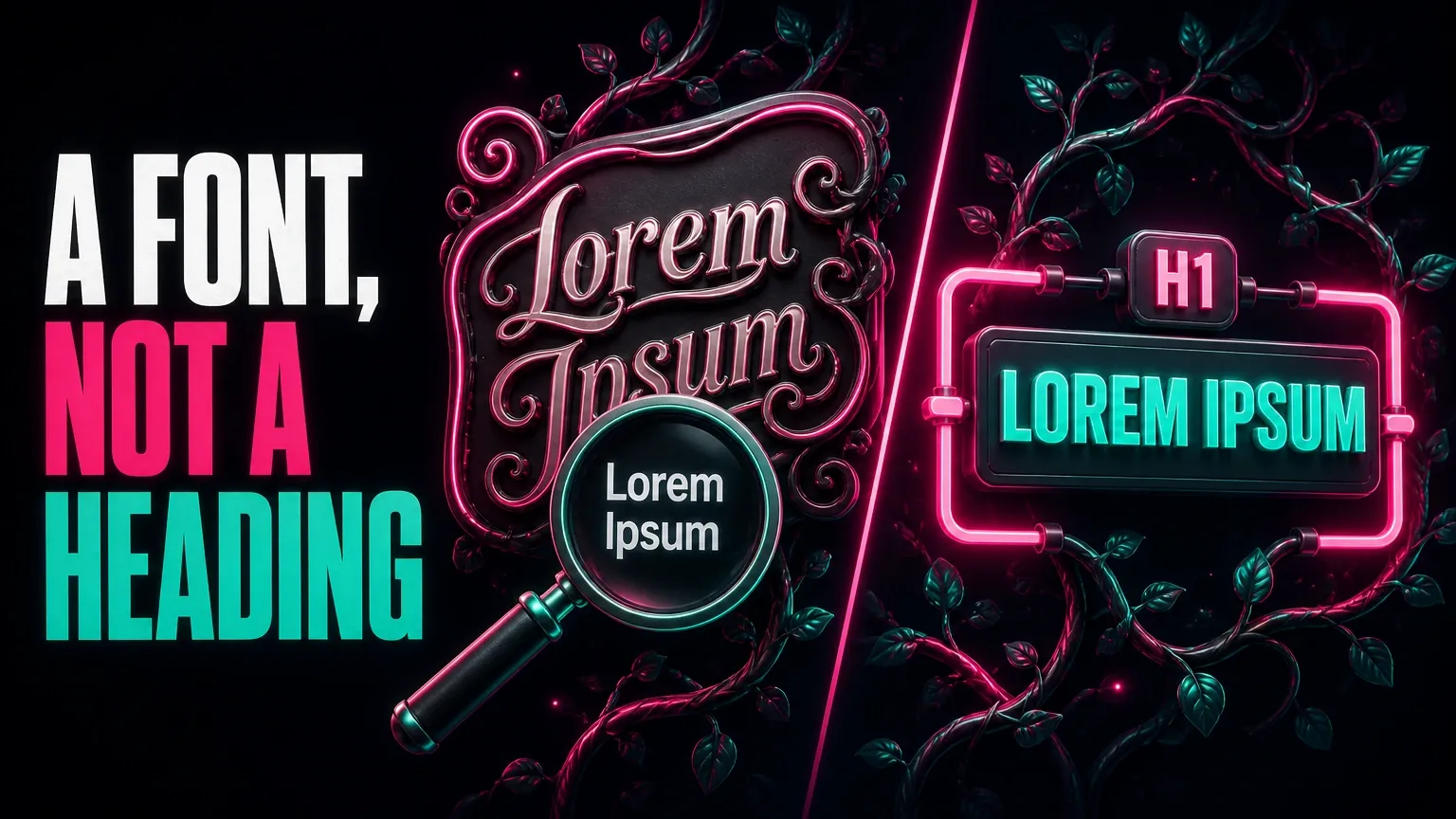
I once spent most of a week choosing a typeface for a headline that wasn’t, as far as any search engine could tell, a headline.
It was set enormous, letter-spaced, in a color I still like. In the code it was an ordinary paragraph in a nice coat.
Your winery homepage may be pulling the same trick right now, an estate name the size of a barn door that no machine reads as a heading.
Nobody caught mine for an entire year, including the man cheerfully sending the invoice.
So take the order below from someone who has made the exact mistake sitting at the top of it, slowly, on purpose, for money.
The one line most winery homepages never wrote
Only 63.9% of the winery pages I opened carry an H1, which is 45 of 47 when I rank the trades and the lowest wineries land on anything I check.
A page with no H1 has plenty of headings and has never said which one is the main heading. H1 is the label that says it, and it goes on exactly one line.
73.7% of the pages I put through the same check have one, so getting it right isn’t difficult and isn’t expensive. Wine sites lose it more often than most, because the top of the page is usually a photograph of the vines with the name of the estate laid over the top in a serif nobody actually has to read.
That name is not a heading. It’s a font.
I didn’t trust the number when I first saw it, because an H1 is the kind of thing a template hands you free. So I went back and checked myself the slow way, setting the industry box in the explorer at the foot of my report, leaving the cities on all, and reading the sample size the card prints under each rate. It held: 972 wineries in the sample, 761 sites I could open and audit.
Say you’ve got one evening and no budget. Where would you spend it?
First: one line that says what you are
Write a sentence that tells a stranger what the business is and where it is. Family winery and tasting room in the hills north of town. Something a person could repeat to a friend without looking it up.
Then make that sentence the main heading on your homepage, in place of the estate name currently sitting up there by itself.
In almost every editor I’ve touched, the heading block has a little dropdown on it, and one of the options is Heading 1. Click it. The technical part ends there.
Why first? Because it costs about ten minutes, and because a heading is the single piece of writing on your website that a search engine, a screen reader and an impatient customer all consult at the same moment.
Write it for the machine on its own and you get what I once handed a moving company: a line that passed every check I own and told his sister nothing.
Every winery site I take on gets its heading written before anyone picks the photograph that sits behind it. That order used to be the other way round and I lost arguments about it for years.
Would your line survive being read out loud in a bar? If not, it’s still a font.
Second: a box she can type into
18.9% of these homepages carry a contact form, where 28% of small business sites in general manage one, which is not a high bar to miss by that far.
Picture the woman planning her mother’s birthday. Eleven people, a Sunday in October, and she wants to know whether you can seat them outside.
It’s nine o’clock at night, and your page offers her a telephone number alongside a set of opening hours that don’t begin again until Monday morning.
So she’d have to remember, tomorrow, in the middle of a work day, to ring a stranger about a booking she could have described in four lines.
She won’t. She’ll book the place whose page let her type at nine o’clock, and you’ll never find out she nearly picked you.
She’s after proof you’re open and pouring this season too, and your trade links the feed better than anyone. The proof itself usually sits three screens down, which is the same as nowhere.
Name, date, how many, and what she wants. Four boxes. Any more than that and you start losing her again.
Every form I’ve ever installed arrived with the same objection attached, which is that people in this business would honestly rather telephone. Some would, and they still do.
The ones who wouldn’t have telephoned are the entire reason the box is sitting there.
How many bookings has your homepage taken while you were asleep? One site I look after took two last night, for an owner who spent a decade insisting her customers preferred to ring.
Third: turn the counter on
Nothing above tells you whether any of it worked.
49.3% of these sites run analytics, under the 58% I get across small business sites, so most owners in your trade will change something on the website this year and never learn a thing from having done it.
It’s free, and installing it takes about as long as making coffee, which is a sentence I have now said to a great many owners without once being believed.
It goes on before launch on every site I build, and the rest of that pre-launch list is mostly jobs about this size.
You don’t have to look at it every week either. Look in March, look again in September, and notice whether the tasting page gets opened more after you fixed the heading.
Do you know how many people read your events page last month? Or is that a shrug?
The one I’d leave alone this year
A blog.
24.3% of these sites publish anything with a date on it, and I know exactly what a consultant will do with that number when he gets hold of it.
He’ll be right about the potential and wrong about the timing. Wineries have better stories than almost any trade I audit. Harvest, weather, the year that went badly, the barrel that surprised everybody in the room.
A blog repays you over years rather than weeks, which makes it a wonderful investment for a business with spare evenings and a fairly cruel one for a business without any.
I still wouldn’t start one this month.
It’s the most expensive job on the whole list, in the only currency you’re actually short of, which is Tuesday evenings. And a beautiful post can’t rescue a homepage that never introduced itself.
Come back to it in the winter, when the top of your page says what you are and there’s a box on it a stranger can type into.
Do the heading, ignore the rest
Ten minutes, tonight, on the homepage only.
Swap the estate name for that sentence and set the block to Heading 1.
The form can wait a month. The counter can wait until you care. The blog can wait until it rains.
The migration someone keeps pitching you can wait forever, because nobody has ever bought a case of wine on account of WordPress.
I’d rather you did one line properly than nodded along at three jobs and opened a new tab, which is what happens almost every time I hand an owner a list.
Want me to check yours before you touch it? Send me the address and I’ll read you back the line your homepage currently believes is its headline.
Bring a drink. Some of them are funny.