WordPress Wasn’t the Difference Between Two Gaming Rooms
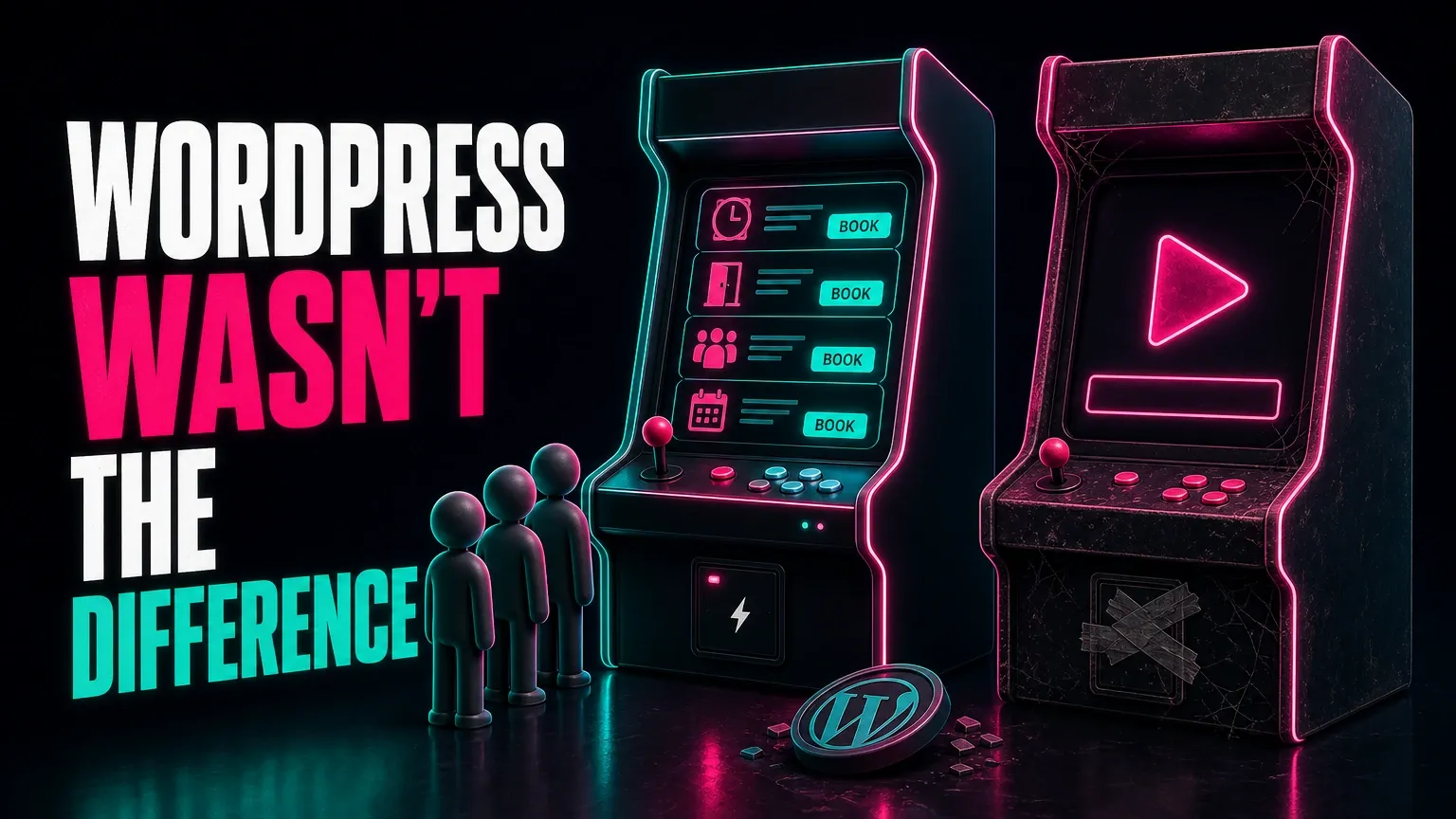
31.0% of gaming websites run WordPress, under the 36.4% I find everywhere else, and the quiet room of my two is the one on it. The real difference turned out to be a Monday habit and a block of code nobody sees.

For about three years I could name the platform a gaming website was built on within four seconds of it loading, and I was insufferable about it.
Squarespace by the way the footer sat. Wix by how the page moved when you scrolled. WordPress by the little tail on the address of the blog posts.
I used to do it out loud on sales calls, unprompted, to people who had just asked me a serious question about their own business.
Nobody has ever hired me for that trick. One prospect asked me, very politely, whether it mattered, and I gave him about four hundred words back, which is how you can tell the honest answer was no.
When did you last choose anywhere based on what its website was built with?
Two places, same games, opposite years
Two gaming businesses I know well, much the same size, much the same machines, prices within a couple of dollars of each other.
One is booked out most weekends and runs a waiting list for its Saturday tournament. The other has a beautiful website and a quiet Tuesday that has spread into Wednesday and is now making a move on Thursday.
The quiet one runs on WordPress. The busy one doesn’t.
Hand me those two homepages back in 2018 and I’d have told you with total confidence which of them was the serious business, and I’d have had it exactly backwards.
Which one would you have bet on?
What the platform split looks like
31.0% of the gaming websites I audited run on WordPress, against 36.4% of every small business site I checked, so your trade shops around a bit more than most.
You can see why. Shopify turns up on 10.8% of them, which is an awful lot of merch tables that quietly grew into web stores.
I audited 2,167 gaming websites to get those shares, and the fingerprinting behind them is honest rather than clever, because a site can match two platforms at once and plenty of them match nothing I can put a name to, so the list never adds up to 100. If you’d sooner look than take my word for it, set the industry box in the explorer on my report to Gaming, leave the city box showing every city, and the platform block prints at the bottom of the card that comes back, with the number of sites standing behind each share.
None of it told me a single useful thing about my two.
A charity homepage carrying eleven plugins and one donate button made the same point to me last year, because the software was never the villain there either.
Why the platform question gets asked at all
“Should I be on WordPress?” is the question I get most in this trade, and it’s almost never the question the person actually has.
What they mean is that something isn’t working, and they’d like the reason to be a thing they can buy.
I understand that completely. A migration has a start date, a finish date and an invoice, while “your homepage never says what an hour costs” has none of those and can’t be handed to a supplier.
If you want the comparison anyway, I’ve put two of the big builders side by side at length. It’s a shorter argument than anyone expects, and it settles nothing about whether your Saturday sells out.
So what would you actually be buying?
The thing I expected to find
I assumed the quiet one was slow, because slow is the first place I look and the failure that costs you a sale while the customer is still standing outside your door.
She’s on the sidewalk with one bar of signal, deciding whether to walk in, and your homepage is a white rectangle with a spinner turning in the middle of it. She doesn’t wait for it. She taps back, opens the next result, and you never find out she was there at all.
Google loads your homepage on a middling phone and marks it out of 100 for exactly that. Neither of my two was slow enough to blame, though the trade as a whole averages 56 out of 100 and comes 33 of 47 on speed, and the busy one was the slower of the pair.
So much for that theory, which I’d been carrying into meetings for years.
What the results said before anyone clicked
The busy one turns up in a search with its opening hours attached to the result. The quiet one turns up as a name and one sentence.
She searched at seven on a Friday, and one of those two answered a question for her before she’d spent a tap on it.
68.0% of gaming sites use schema markup, against 70.5% across everything I audit. Schema markup is the gap between a page a person can read and a page a machine can quote from, and the machine is the one building the screen she’s deciding on.
The quiet one had none of it, and I stopped expecting any platform to sort that out on its own about six years ago.
The Monday habit
The busy one writes up the Saturday tournament every Monday morning. Results, the upset in round three, a photo of the kid who beat the regulars, four hundred words at the outside.
It reads like a club newsletter, because that’s what it is.
40.1% of gaming sites publish a blog, a bit ahead of the 37% I get across everything I audit, and yours is one of the few trades where I think the habit earns its keep, because your customers are the sort of people who come back to read about themselves.
The quiet one has a news page. Last post, a launch announcement, two summers old.
What does your site say this week that it didn’t say last week?
The tell I missed for years
I asked the quiet one’s owner what he’d changed on the site in the last two years.
Nothing, he said. It’s finished.
The busy one’s owner couldn’t answer that question at all, because he’d changed something that week and couldn’t remember what it was.
One of those websites is a building. The other is an event that keeps happening, and I know which one a stranger meets on a Friday.
So what separated them?
Both had a website. Both looked professional. One of them treated the site as a front desk and the other treated it as a brochure, and what the thing was built on had nothing to do with which was which.
The busy one answers the questions a stranger arrives with, on the first screen, in plain words: what it costs, when it opens, how you book, and what happens if you’ve never played before.
The quiet one opens with a trailer and a slogan.
Owning a website is the check your trade already wins. Being bookable is the one that fills a Friday, and hardly anybody keeps score on that one.
Your own site is already one of those two things, and you knew which one before you finished this sentence.
If you want to see the front desk version done properly, I keep a handful of gaming sites here that get it right, and they’re worth ten minutes of a Sunday.
I build gaming websites for a living, so you’d expect me to end this by selling the quiet one a rebuild. He didn’t need one and I told him so, which cost me a job I’d have enjoyed. I do that more often than my accountant would like, and a flower shop got three cheap jobs out of me and a flat no on the expensive one.
Your turn at my old game
Open your own homepage on your phone tonight and play the four second version.
Not the platform. Anyone can guess that, and it turned out to be the least useful thing I ever taught myself to spot.
Four seconds, then look away. Can you say what the place costs, when it opens, and how a stranger says yes to it?
If all you came away with was the name and a nice photo, your customer came away with less than that, because she wasn’t trying anywhere near as hard as you were.