Two Tabs Tonight, and Only One Flatters Your Clinic
Healthcare describes 60.0% of the pictures on its websites, beaten by only three trades anywhere I looked, and then averages 4.3 stars. Open one tab on a computer and one on your phone, and you can see both of those tonight.


My own Google listing sat on four reviews for about three years, one of them written by my mother, while I was busy telling clinics how to run theirs.
In those same three years I could have recited from memory the sentence attached to every photograph on my website, because I typed all of them myself, on a Sunday, unpaid, for the pleasure of it.
Do the invisible part beautifully. Skip the part everybody actually looks at.
Your trade does the very same thing, and I went and counted it across a long list of practices, clinics and health services. So open two tabs while you read this, because the whole check runs about five minutes, and one of the two tabs is going to cheer you up enormously.
Tab one: your pictures
-
Open Google Images on a computer, because this one is miserable on a phone.
-
Type site: followed by your web address, with no space after the colon, then hit go.
-
Read the line printed underneath each picture that comes back to you.
What you’re looking at is the portion of your website a stranger can arrive at by looking rather than by reading, and it’s a peculiar feeling the first time.
Is your building in there? Your waiting room, your reception desk, anybody who actually works for you?
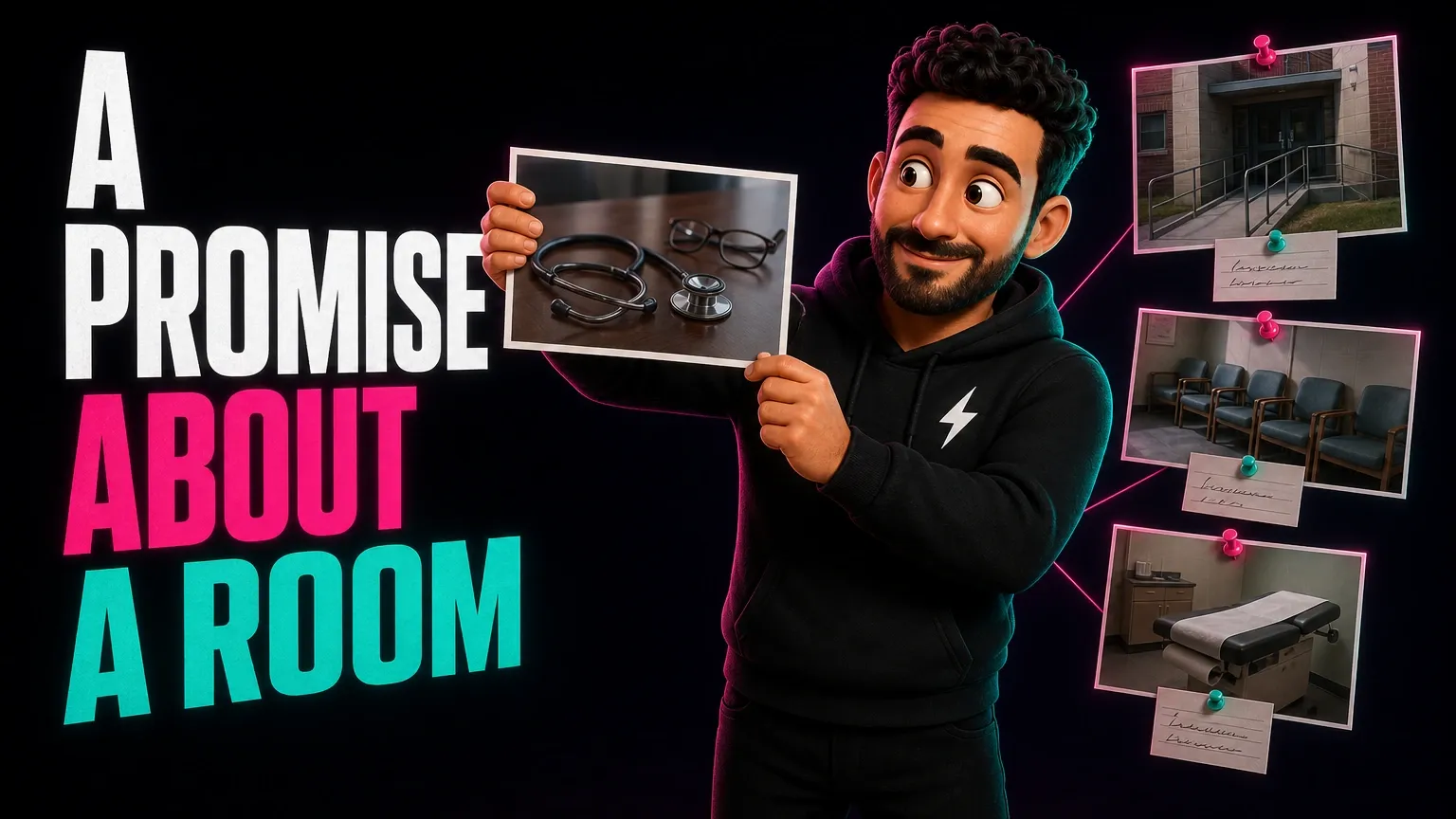
If what comes back is a logo, a map pin and a photograph of a stethoscope lying on a desk, your camera had nothing whatsoever to do with it.
I swapped four photographs on a clinic homepage one winter and left every other thing on the page alone, and the difference between the two versions was embarrassing.
The box behind every photo
Upload a picture to your own website and most tools open a small field beside it, labeled alt text on the tools that name it at all, description on the rest of them.
Nobody reads that field on the page. It isn’t part of the design, and no patient will ever see a word of it.
Leave it empty and nothing on your screen breaks, because the photo still loads, the page still looks right, and whoever built it still gets paid on Friday afternoon.
What breaks is outside your page. A picture with an empty box is filed under nothing at all, so it can’t be handed to a stranger who goes looking for it, and it finishes up doing about as much work for your practice as the color of your header does.
Now the flattering part. Healthcare sites describe 60.0% of their images, against 54.9% across everything I audited.
Hospitality beats you on it, and so do florists, and so do plastic surgeons, one of whose galleries I once hid on a phone rather than fix properly. Nobody else does, which leaves this trade 4 of 47 on a check most industries treat as entirely optional.
I think I know the reason, and it has very little to do with discipline. Your photographs are of rooms, so someone had to stand in a corridor with a phone to collect them, and the sort of person who bothers with that tends to bother with the sentence underneath as well.
Tab two: the number under your name
-
Pick up your phone. Not the computer, the phone.
-
Search your practice name with your town after it, the way a stranger would, and don’t sign in to anything first.
-
Read the small number printed beside the stars, then read your three most recent reviews.
Fifteen seconds, and I’d bet most owners reading this haven’t looked since the spring.
Healthcare averages 4.3 stars, which lands 44 of 47, with wedding photographers and painters sitting way up at the top of that ranking and restaurants directly underneath you.
You aren’t invisible either, because 91.9% of the businesses I sampled in this trade hold at least one Google review, a good deal better than the 88% I count everywhere else.
People are rating you. They’re rating you badly.
My run through this trade was going along nicely until I reached that column, and I sat looking at it for a while.
Did you already know that number this morning, or have you just found it out?
Why the two tabs disagree
Those photo descriptions were typed on an afternoon when a person was being paid to build a website and had a list of jobs in front of them.
Your rating gets typed at half past ten on a Sunday night by a woman who waited fifty minutes in March and then opened a letter from her insurance company in April.
One of those is a job of work. The other one is weather.
Two numbers off the same business rarely agree about anything. I used to read a wall of stars as a promise that the website behind it would be fine, and furniture stores cured me of that.
And the weather is rougher in your trade than in almost any other I look at. A man who loves his haircut says so on the way out of the door, while a man whose knee stopped hurting six weeks later never mentions it to a living soul.
The two people carrying a story worth telling are the one who waited and the one who got the bill, and both of them have a phone in their hand.
So who in your building owns that number? In every practice I’ve ever sat in, the honest answer has been nobody at all.
The part of it you can move
Nobody writes a review about an ordinary Tuesday, so the quiet middle of your patient list stays quiet until you go and ask it something.
Ask, then. Ask at the right moment, which is never on the way out of the door with a parking meter running, but a week later when the thing you fixed is still fixed, and ask with a link she can tap once.
How many of your last twenty patients did anyone ever ask? I know the answer at my own place, and it took me years to be able to say it out loud.
Do not put a tablet on the front desk asking people to rate you before they’ve left the building. A review written in your lobby reads like a review written in your lobby, and the family comparing three practices at midnight can smell it from where they’re sitting.
When a practice hires me to sort out its website, tab two is where I look first these days, and more often than not I finish the call by saying the website isn’t the problem. Strange thing to tell a person who rang up to buy one.
Where the numbers came from, and where they go soft
I’d far rather you argued with the numbers than with me. My report carries an explorer that prints the same rollup I’m reading from, one trade at a time, so long as you set healthcare and leave the other box on all, and every check turns up beside the number of sites it was counted from, which for this trade is 2,601 websites I could open and read.
Then the soft part, which I’d feel like a fraud leaving out of this.
My check asks whether that box has anything at all inside it, and it holds no opinion whatsoever about what.
A camera file name passes. So does the word image, and so does your own practice name, pasted into every box on the page by a plugin nobody remembers installing.
So tab one is being kind to you, and the real distance between your two tabs is wider than these numbers make it look. Does that land better or worse than the number did?
If you’d sooner I opened your pictures myself and told you what each one is currently claiming to be, that’s what the free audit is for.
Neither tab is your website
The rest of it holds up, by the way. Healthcare comes out at 73 out of 100 across the ten checks I run, which puts it in the better half of the trades I grade and is nothing to apologize for.
Nothing about this trade is broken. A couple of free habits are missing, and the habit that looks expensive has already been taken care of.
Two tabs, then. One of them shows careful work nobody asked for and nobody will ever notice, and the other shows a number every new patient reads before she reads a single word you wrote.
Same practice. Same year. Same people.
So which of the two deserves your Saturday morning? I know which one I’d pick, and I’ve been wrong about it before now.